
Author: Jwell 2026-05-20


In recent years, driven by the robust development and large-scale expansion of the domestic PE industry—and capitalizing on inherent advantages such as being non-polluting, long-lasting, and possessing superior physical properties, excellent resistance to corrosion and aging, good cold resistance, abrasion resistance, and high impact strength—PE piping has emerged as the preferred choice for large-diameter pipelines in the municipal water supply and drainage sector. This success is attributed to its light weight, ease of installation, superior jointing methods, excellent flow characteristics, and cost-effectiveness, presenting a highly promising outlook for future growth. Currently, the PE piping market is dominated primarily by HDPE products, a category that encompasses solid-wall pipes for water supply and drainage, single- and double-wall corrugated pipes, steel-reinforced corrugated pipes, gas pipelines, pipes for conveying mineral slurries, sand, and silt, agricultural drip irrigation tubing, and various other composite, modified, and cross-linked pipe systems.
Classification of PE Pipe Raw Materials
First and foremost, the selection of HDPE material is critical; different grades of HDPE possess distinct performance characteristics and must be screened based on actual production requirements. For instance, when manufacturing large-diameter PE pipes, the preferred HDPE grade is PE100. This material exhibits outstanding resistance to pressure, impact, and corrosion, while simultaneously meeting the rigorous strength requirements inherent to large-diameter piping.
However, for the production of thick-walled pipes, it is advisable to select grades that feature "anti-sag" properties. During the manufacturing process of thick-walled pipes—due to the substantial material thickness—there is a propensity for "melt sag" to occur. HDPE materials endowed with anti-sag capabilities maintain superior stability at elevated temperatures, thereby guaranteeing the quality and structural integrity of the finished pipes.
Beyond the two scenarios mentioned above, several other factors warrant consideration. For example, pipes intended for prolonged exposure to outdoor environments should be manufactured using HDPE grades that demonstrate superior weather resistance; conversely, pipes designed to convey corrosive media require HDPE grades characterized by exceptional corrosion resistance.
Consequently, when selecting HDPE materials, it is imperative to identify the most suitable grade based on specific production demands, thereby ensuring that the manufactured pipes are capable of meeting operational requirements across a wide spectrum of complex environments. Furthermore, during the production process itself, meticulous attention must be paid to processing techniques and quality control measures to guarantee that the resulting pipes exhibit stable and reliable performance.
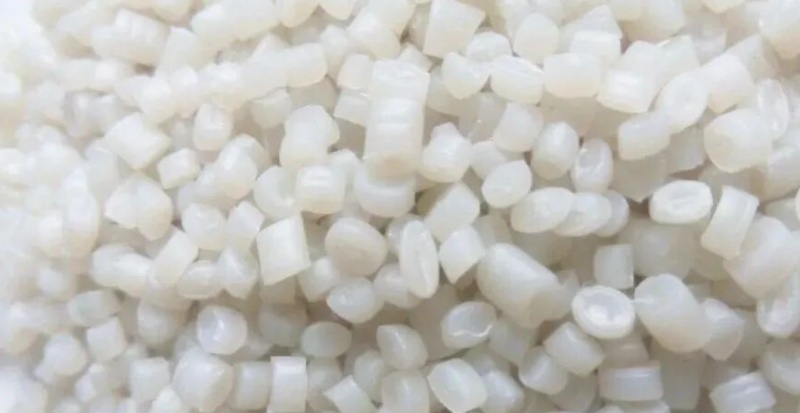
To meet specific extrusion process requirements, extrusion machine must possess corresponding capabilities, primarily encompassing aspects such as screw design, melt temperature control, pipe mold design, vacuum control, traction speed ratio control, and automatic cutting mechanisms.
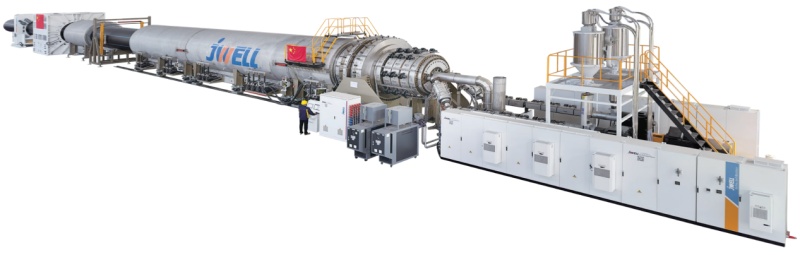
JWELL LARGE DIAMETER PIPE EXTRUSION LINE
Extruder Section
For the production of large-diameter HDPE pipes, JWELL Machinery employs a proprietary main extruder series featuring a length-to-diameter (L/D) ratio of 40, paired with a spiral feed bushing. This configuration ensures high output rates while simultaneously guaranteeing optimal material plasticization and low melt temperatures. For pipe specifications with an outer diameter (OD) of 800 mm or greater—and wall thicknesses corresponding to SDR 11 or higher—the extruder is equipped with a rear-mounted melt cooler. This device reduces the melt temperature before the material enters the die, thereby minimizing "melt sag" as much as possible while simultaneously allowing for a reduction in the length of the vacuum cooling tank; ultimately, this ensures exceptional uniformity in the pipe's wall thickness.

Mold design
The single-layer or multi-layer die features a spiral structure, incorporating a multi-spiral flow distributor design as well as air and oil cooling mechanisms to minimize material residence time within the die and further stabilize the melt temperature.
Vacuum Control
During the vacuum cooling and forming stage of pipe production, the implementation of a fully automated negative-pressure closed-loop control system ensures rapid pipe formation and provides a swift dynamic response. Furthermore, the system is capable of detecting vacuum leaks in real time and automatically compensating for them, thereby enhancing the stability of the vacuum sizing process. Additionally, by automatically regulating the rotational speed of the vacuum pump, the system not only significantly reduces noise levels within the vacuum tank but also achieves substantial energy savings, with an energy-saving rate exceeding 50%.

Stable Traction
The system employs a "one-to-many" synchronous control scheme—where a single drive unit simultaneously powers multiple permanent magnet synchronous servo motors—offering the advantage of stable torque output at low frequencies. Furthermore, its wide speed regulation range ensures a smoother production process and minimizes potential product waste. Regarding the traction tracks, a self-expanding contour-following mechanism is utilized to ensure a tight, precise fit between the chains and the guide rails, thereby guaranteeing the accuracy of the traction speed.

Automated Cutting
It features a fully automated, dust free cutting mechanism capable of cutting thicknesses up to 160 mm. Furthermore, it is equipped with a "one-touch automatic diameter adjustment" function, rendering the dust free cutting of ultra-thick pipes remarkably simple and intuitive—enabling the rapid cutting of pipes with varying specifications.
Overall, selecting appropriate materials and matching equipment, optimizing production processes, and enhancing the level of automation and quality control can effectively improve the production quality and efficiency of large-diameter HDPE pipes.
Changzhou Jwell Machinery Co., Ltd. Established in 1997, JWELL has been ranked as top 1 in the Chinese extrusion industry for more than 15 consecutive years. As a global supplier of complete solutions for extrusion technology. JWELL has a long history and rich technology accumulation. With more than 1,016 patents and 9 production bases. Attending for endurance, striving for innovation and focus on customers' experience is JWELL'S permanent enterprise spirit, JWELL people actively confront with new industrial challenge and new materials and new processes. We constantly accelerate the research and development of new technologies, focus on the new energy utilization, automotive lightweight composite materials and medical disposables and medical packages. We commit to the cutting-edge technology of plastic processing and recycling. Continuously innovate and develop extrusion equipment in the polymer subdivision field. JWELL has a modern assembly workshops, 9 large components processing workshops and precision CNC machines. Unique processing technology, we strive to ensure the stability of each component. Pay attention to parts inspection and quality control and ensure the precision and reliability of all parts. Quality excellent, perfect as one.exceptional customer satisfaction. We understand and respect customers' vision and strategy. With our professionalism and dedication, we continuously improve the quality of our products, provide customers with overall solutions. And constantly create value for customers.

In recent years, driven by the robust development and large-scale expansion of the domestic PE industry—and capitalizing on inherent advantages such as being non-polluting, long-lasting, and possessing superior physical properties, excellent resist...

You are cordially invited to visit our booths at CHINAPLAS 2026 in Shanghai to learn about our latest developments in extrusion, blow molding, and recycling technologies.

A premium-grade invisible car wrap serves as both a protective shield for the factory paintwork and a time-preserving mechanism that keeps your cherished vehicle looking as good as new for a decade. High-end wraps are not merely a physical barrier; they...

Once, there was an implementation of the plastic ban.Plastic straws were rapidly removed out of the market, while paper straws became mainstream in an extremely short period of time. The straws in milk tea shops have all been replaced with paper straws, ...
 EN
EN ES
ES PT
PT AR
AR RU
RU FR
FR BG
BG HR
HR DA
DA NL
NL DE
DE EL
EL IT
IT JA
JA KO
KO NO
NO PL
PL RO
RO SV
SV TL
TL IW
IW ID
ID LT
LT SR
SR UK
UK VI
VI ET
ET HU
HU MT
MT TH
TH TR
TR FA
FA AF
AF MS
MS SW
SW BE
BE IS
IS AZ
AZ KA
KA LA
LA ZU
ZU KK
KK TG
TG UZ
UZ KY
KY XH
XH

