
Home > showlist
Today, we are informing you about a very distinct machine, the plastic film extruder. It is a plastic film extruder, a machine that can produce the thin sheets of plastic that are used in many products we use every day. So, what do we know about how these Jwell plastic film extruder work, and why they matter?
Plastic film extruders function by melting down plastic pellets under heat and pressure and turning them into a thin film. The Jwell plastic film extruder machine has a long barrel with a turned screw by a three-phase motor to slowly move the plastic pellets down the barrel and heat them. The pellets are melted as they move through the barrel. The liquid plastic is pressed through a die that forms it into a thin film. Finally, the film is cooled with air or water and rolled onto a spool.
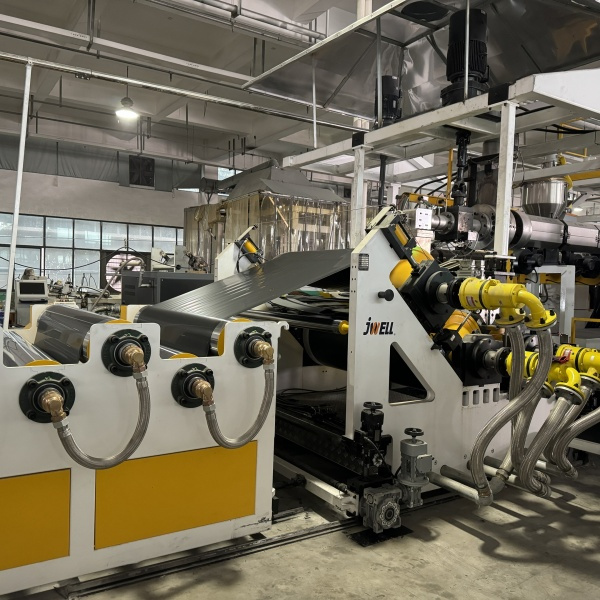
Benefits of a Plastic Film Extruder There are numerous benefits associated with a plastic film extruder. One advantage is that it is possible to rapidly manufacture large volumes of plastic film. This could also help companies turn out more plastic products at a time of intense demand. Another advantage is that plastic film extruders are general purpose machines that can produce films of various thicknesses and widths. It provides for adaptation and versatility in manufacture. Moreover, Jwell plastic film extrusion machine is a low-cost equipment, which can also reduce production cost for enterprises.

There are varieties of the plastic film extrusion process that can be utilized depending on what the film will be used for. Blown film extrusion, cast film extrusion and coextrusion are some of the most frequent. Blown film extrusion refers to the step of air bubbling in the middle of the film to expand into a bubble. Cast film extrusion Spread the melted plastic evenly onto a flattened surface to form a thin film. Coextrusion entails the combination of two or more plastic films to form a film having one or more desirable properties, such as barrier or strength properties. Each form of extrusion process has a distinct advantage and application.

Numerous advances in plastic film extrusion technology have been realized in recent years which have led to increased output and quality of the extrusion process. One development has been designing of dies and control of the film thickness and properties using a computer-aided design (CAD) software. Another advance involves the creation of new materials and additives that can add functionality to plastic films, for example, increasing their strength or barrier properties. In addition, improvements in cooling and winding technology have served to enhance the quality and the uniformity of the plastic extruded films.
 EN
EN ES
ES PT
PT AR
AR RU
RU FR
FR BG
BG HR
HR DA
DA NL
NL DE
DE EL
EL IT
IT JA
JA KO
KO NO
NO PL
PL RO
RO SV
SV TL
TL IW
IW ID
ID LT
LT SR
SR UK
UK VI
VI ET
ET HU
HU MT
MT TH
TH TR
TR FA
FA AF
AF MS
MS SW
SW BE
BE IS
IS AZ
AZ KA
KA LA
LA ZU
ZU KK
KK TG
TG UZ
UZ KY
KY XH
XH


