 EN
EN ES
ES PT
PT AR
AR RU
RU FR
FR BG
BG HR
HR DA
DA NL
NL DE
DE EL
EL IT
IT JA
JA KO
KO NO
NO PL
PL RO
RO SV
SV TL
TL IW
IW ID
ID LT
LT SR
SR UK
UK VI
VI ET
ET HU
HU MT
MT TH
TH TR
TR FA
FA AF
AF MS
MS SW
SW BE
BE IS
IS AZ
AZ KA
KA LA
LA ZU
ZU KK
KK TG
TG UZ
UZ KY
KY XH
XH
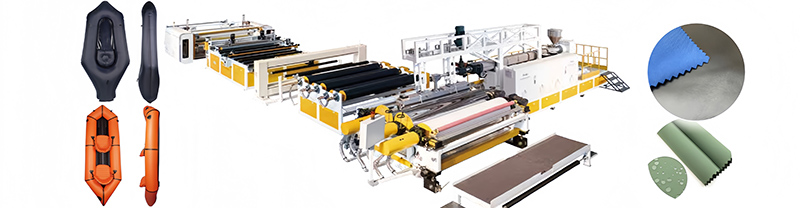
The Extrusion Coating Process and the Casting Process are two common methods used in the production of TPU hot melt adhesive films. They differ in terms of principle, equipment, and process flow. Below is a detailed introduction to the characteristics and differences between these two processes.
Extrusion Coating Process
The extrusion coating process involves applying the hot melt adhesive evenly onto a substrate through a coating head, followed by steps such as drying and cooling to form the film.
Process Flow
(1) Raw material preparation: The TPU hot melt adhesive is prepared according to a specific formula.
(2) Coating: The adhesive is evenly applied onto the substrate through the coating head.
(3) Drying: The coated substrate is sent into an oven, where solvents are evaporated using hot air to cure the adhesive film.
(4) Cooling: The dried film is rapidly cooled using a cooling device to achieve the required mechanical properties.
(5) Winding: The finished hot melt adhesive film is wound up using a winding device.
Characteristics
(1) High production efficiency: The extrusion coating process allows for continuous production, offering high efficiency.
(2) Uniform film preparation: This process enables precise control over film thickness, resulting in excellent uniformity.
(3) Wide applicability: It is suitable for producing hot melt adhesive films of various thicknesses and for different applications.

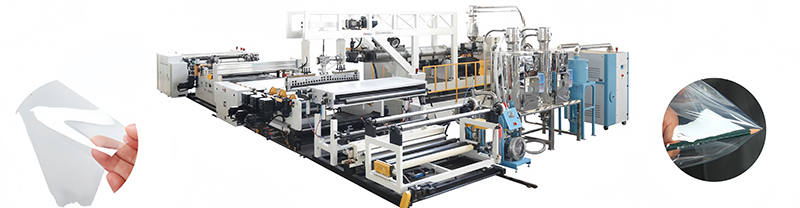
Casting Process
The casting process involves extruding the hot melt adhesive into a film shape through an extruder, followed by steps such as cooling and stretching to form the final film.
Process Flow
(1) Raw material preparation: The TPU hot melt adhesive is prepared according to a specific formula.
(2) Extrusion: The adhesive is extruded into a film shape through the screw of the extruder.
(3) Cooling: The extruded film is rapidly cooled using a cooling device to achieve the required mechanical properties.
(4) Stretching: The cooled film is stretched using a stretching device to modify its physical properties.
(5) Winding: The finished hot melt adhesive film is wound up using a winding device.
Characteristics
(1) High production speed: The casting process enables high-speed extrusion, resulting in faster production.
(2) Wide film width: This process can produce wide hot melt adhesive films, making it suitable for large-area applications.
(3) Good mechanical properties: The casting process can enhance the mechanical properties of the film through steps such as stretching.
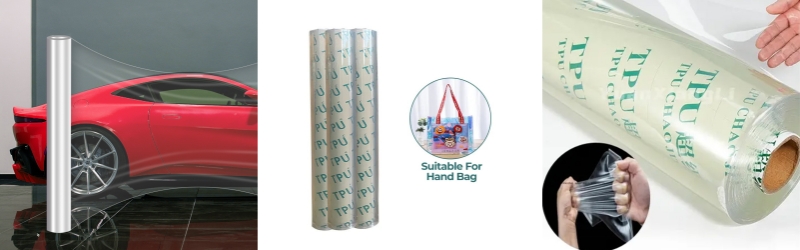
Summary
Both the extrusion coating process and the casting process are commonly used methods for producing TPU hot melt adhesive films. The extrusion coating process is ideal for producing thinner films with high uniformity requirements, while the casting process is better suited for wide films with higher mechanical performance demands. The choice between the two processes should be based on specific product requirements, production efficiency, equipment conditions, and other factors.
Changzhou Jwell Machinery Co., Ltd. Established in 1997, JWELL has been ranked as top 1 in the Chinese extrusion industry for more than 15 consecutive years. As a global supplier of complete solutions for extrusion technology. JWELL has a long history and rich technology accumulation. With more than 1,016 patents and 9 production bases. Attending for endurance, striving for innovation and focus on customers' experience is JWELL'S permanent enterprise spirit, JWELL people actively confront with new industrial challenge and new materials and new processes. We constantly accelerate the research and development of new technologies, focus on the new energy utilization, automotive lightweight composite materials and medical disposables and medical packages. We commit to the cutting-edge technology of plastic processing and recycling. Continuously innovate and develop extrusion equipment in the polymer subdivision field. JWELL has a modern assembly workshops, 9 large components processing workshops and precision CNC machines. Unique processing technology, we strive to ensure the stability of each component. Pay attention to parts inspection and quality control and ensure the precision and reliability of all parts. Quality excellent, perfect as one.exceptional customer satisfaction. We understand and respect customers' vision and strategy. With our professionalism and dedication, we continuously improve the quality of our products, provide customers with overall solutions. And constantly create value for customers.


