 EN
EN ES
ES PT
PT AR
AR RU
RU FR
FR BG
BG HR
HR DA
DA NL
NL DE
DE EL
EL IT
IT JA
JA KO
KO NO
NO PL
PL RO
RO SV
SV TL
TL IW
IW ID
ID LT
LT SR
SR UK
UK VI
VI ET
ET HU
HU MT
MT TH
TH TR
TR FA
FA AF
AF MS
MS SW
SW BE
BE IS
IS AZ
AZ KA
KA LA
LA ZU
ZU KK
KK TG
TG UZ
UZ KY
KY XH
XH
The appearance and performance of automotive interior(#jwell abs plate extrusion machine) components are largely determined by the formulation design of color masterbatches. These color masterbatches, which use polypropylene as the carrier, not only need to meet the requirements of good gloss and no color shift between similar colors, but also need to strictly control the VOC content and adapt to the special usage environment of automotive interiors. The formulation design of color masterbatches for automotive interior color components is shown in table below (Blow-molding film grade color masterbatch formula).
| Raw material | Specification | Content | |
| Paint | Inorganic pigments | 0-60 | |
| Organic pigments | 0-30 | ||
| Wetting agent | Polyethylene wax | Density: 0.91 - 0.93 | 0-8 |
| Stabilizer | Zinc stearate | 0-0.5 | |
| Antioxidant | Resorcinol, phosphite, sulfur ether PP | 0-0.5 | |
| Carrier Name of raw material | PP | MI 20-50 | X |
| LLDPE | MI 1.5 -50 | ||
| Total | 100 | ||
This article will focus on the core points of color masterbatch formulation for automotive interior components, and will dissect the key technologies in industrial production from the following aspects, providing practical references for industry practitioners.
1. Similar color, different spectrum
2. Glossiness
3. Colored Composite Inorganic Pigments
4. Application of Carbon Black
5. VOC Control
Similar color, different spectrum
The biggest challenge in the selection of plastic masterbatch for car interior color components is to avoid the phenomenon of "same color but different spectra".
It requires achieving the matching of different plastic color samples and the same color target under various light sources. Each object has its own unique spectral reflectance curve. When this object reflects the visible spectrum to the observer under a specified light source, a spectral tristimulus value will be generated.
When the spectral tristimulus values of two objects with different spectral reflectance curves are equal, it is considered that these two objects are conditionally isochromatic.
Once the light source changes, due to the different energy distributions of each source, the generated spectral tristimulus values will be different, which leads to the phenomenon of isochromatic heterogeneity.
Most automotive manufacturers will choose the D65 F11 two sets of light sources as the basis for determining isochromatic heterogeneity. How to avoid the phenomenon of similar colors but different spectra? Firstly, collect a wide range of pigment data, establish a computer database, and adopt computer-aided color matching technology. For example, when using manual color matching, it is necessary to compare automotive pigments and conduct reflection spectrum analysis. This requires higher skills from the color matchers.
Glossiness
As is well known, the colors of most car models are mainly composed of cool tones such as beige, gray, brown, and black. Different shades of beige, gray, and black are named according to their unique characteristics. For example, Y20 (gray), 95T (beige), 82V (black), and 9B9 (black). We call these standard color plates. Different color numbers represent a set of L, a, and b values. The determination of the color of car interior components generally uses a spectrophotometer to compare the color difference with the standard color plates (D65 light source, F11 light source). The color difference range for different color numbers varies, and specific details can be found in the color evaluation specifications for car interiors of each manufacturer, such as Volkswagen's VW50190. Furthermore, the data on colors is often closely related to the mold texture, glossiness, etc. Table below shows the gloss requirements for various interior materials under different colors.
| Raw material | Black | Grey | Beige | |||
| 1 | 3 | 1 | 3 | 1 | 3 | |
| Texture non-crystalline plastics(ABS, PC, PC + ABS, etc.) | 3.4-4.4 | 4.4-5.4 | 3.4-4.4 | 4.4-5.4 | 3.4-4.4 | 4.4-5.4 |
| Texture crystalline plastics (PP, PE, PBT, PET, etc.) | 2.0 i0.2 | 2.0 i0.2 | 2.8i0.3 | |||
Colored Composite Inorganic Pigments
Given that the color components of car interiors are mainly in light tones, beige, and light gray, colored composite inorganic pigments are the preferred choice. They are a kind of doped crystals formed by doping certain or several metal ions into the lattice of other metal oxides. The doped ions cause special interference of incident light. Certain wavelengths are reflected while the rest are absorbed, thus becoming colored pigments. That is to say, various metal oxides are uniformly distributed in the lattice of the new chemical compound, like a solution but in a solid state similar to glassy substance. Chemically, it can be regarded as a stable solid solution. Therefore, it has excellent durability, high covering power, excellent heat resistance, light resistance, weather resistance, chemical resistance, and high infrared reflection performance and partial ultraviolet shielding ability. It can improve the weather resistance, light resistance, insulation performance of plastic products, and extend the service life of the products.
The garnet lattice of the colored composite inorganic pigments incorporates nickel oxide, chromium oxide (III), or manganese oxide as the color-forming components. The elements such as nickel, chromium, manganese, and antimony in these garnet-type pigments fill the original crystal defects in titanium dioxide, forming a more complete crystal structure and enhancing the stability of the crystal lattice.
These metal elements have lost their original chemical, physical and physiological properties. Therefore, this type of rutile pigment cannot be regarded as nickel, chromium or antimony compounds or their simple oxides. The inert nature of mixed metal oxide pigments is very high. The amount of water-soluble substances is below 2ppmm, and human gastric acid simply cannot dissolve them. Thus, even if they enter the stomach and intestines, they are harmless to the human body; contact with the human body is also absolutely safe. For this reason, they are not classified as hazardous substances. According to the manufacturer's instructions on compatibility, purity, and safe handling, most of these pigments are considered non-toxic and comply with the requirements for contact with food and the safety rules for toys.
Application of Carbon Black
For automotive parts or household appliances, a greater number of them are painted in gray or light gray. Therefore, the selection of carbon black is also very important. Carbon black is a type of product formed when hydrocarbon substances undergo incomplete combustion and pyrolysis in a reaction furnace. Depending on the different raw materials and production processes, it is called "furnace black", "lamp black", "gas black", "acetylene black" and "tank black".
Black lamp smoke, also known as lamp black carbon, originated in ancient China and Egypt. At that time, people burned oil and fat in inverted conical porcelain or earthenware basins, and the soot deposited on the cold surface of the basins. They collected it regularly.
Even today, this production method is still largely preserved, except that the raw materials used now are petroleum-based or coal tar-based oils, which are burned on a flat iron plate with a diameter of up to 1.5 meters. The combustion gas containing lamp black is collected by an inner brick-lined exhaust hood, and then through bends and fire pipes reaches the deposition device.
To control the properties of the produced lamp black, it is necessary to ensure that the raw materials mainly undergo incomplete combustion near the gap between the combustion plate and the exhaust hood. In the slightly further pipe, combustion occurs under insufficient oxygen conditions, thus forming larger lamp black particles. For these reasons, lamp black has a wider range of particle size distribution, with the main characteristic being large particle size.
Because only a small portion of the particles formed in the gap between the combustion plate and the exhaust hood can come into contact with oxygen in the air, these lamp blacks have only a small amount of surface oxides, corresponding pH values are neutral, and volatile substances are very few, usually less than 1%. Due to the large particle size of lamp black, its darkness and coloring power are not high. #compoundingmachine
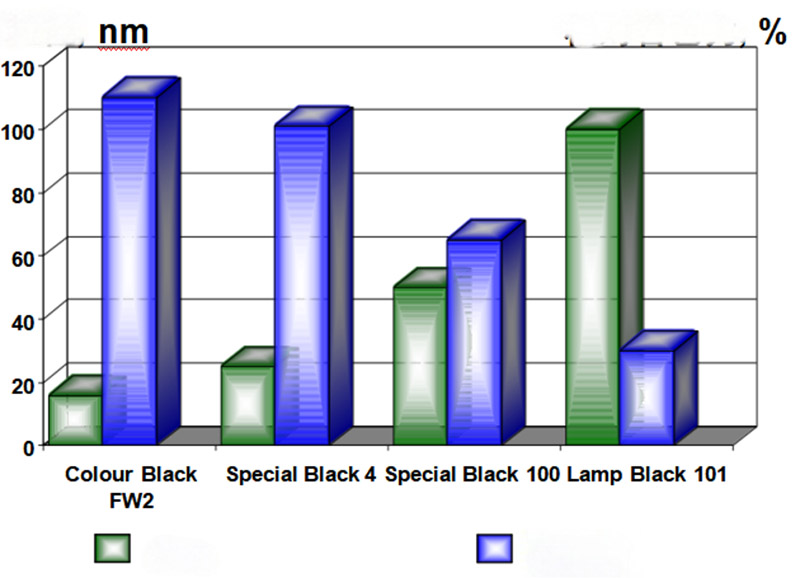
It is well known that gray is usually prepared by mixing a large amount of titanium white pigment with a small amount of carbon black. Especially for automotive parts or household appliances, more gray or light gray is chosen, and the color difference accuracy is required to be higher (ΔE < 0.5, L, a, and b also have certain limits). Since the amount of carbon black added when preparing gray is small, the error caused by measurement transmission makes it difficult to control the color difference of the product. Therefore, using a pigment with lower coloring power can achieve twice the result with half the effort. For example, the German company Elringklinger Lamp Black 101 has a larger particle size of 95nm, a surface area of 20m2/g, a pH value of 7.5, and has good blue phase and dispersibility, making it the preferred colorant for mixing gray. During large-scale production, it can reduce the impact of measurement errors on color stability.
VOC Control
The VOC (Volatile Organic Compounds) in automotive plastic color masterbatches mainly come from functional additives (anti-static agents, UV inhibitors, etc.) and dispersing additives. Therefore, choosing appropriate additives becomes particularly important. In this regard, the well-known polymer additive suppliers both at home and abroad have already improved their products. They have launched a series of additives that have better compatibility with polymers, lower VOC content, no frosting, and no adhesion at high temperatures.
To meet the performance requirements of various automotive components, plastic materials for automotive interior parts are often modified to meet enhanced, toughened, and wear-resistant requirements. Therefore, color masterbatches are used in full-mixing modification granulation. It is necessary to pay attention to the addition ratio and mixing distribution of color masterbatches to ensure that the color difference of the injection-molded products after mixing and granulation meets the requirements.
Changzhou Jwell Machinery Co., Ltd. Established in 1997, JWELL has been ranked as top 1 in the Chinese extrusion industry for more than 15 consecutive years. As a global supplier of complete solutions for extrusion technology. JWELL has a long history and rich technology accumulation. With more than 1,016 patents and 9 production bases. Attending for endurance, striving for innovation and focus on customers' experience is JWELL'S permanent enterprise spirit, JWELL people actively confront with new industrial challenge and new materials and new processes. We constantly accelerate the research and development of new technologies, focus on the new energy utilization, automotive lightweight composite materials and medical disposables and medical packages. We commit to the cutting-edge technology of plastic processing and recycling. Continuously innovate and develop extrusion equipment in the polymer subdivision field. JWELL has a modern assembly workshops, 9 large components processing workshops and precision CNC machines. Unique processing technology, we strive to ensure the stability of each component. Pay attention to parts inspection and quality control and ensure the precision and reliability of all parts. Quality excellent, perfect as one.exceptional customer satisfaction. We understand and respect customers' vision and strategy. With our professionalism and dedication, we continuously improve the quality of our products, provide customers with overall solutions. And constantly create value for customers.


