 EN
EN ES
ES PT
PT AR
AR RU
RU FR
FR BG
BG HR
HR DA
DA NL
NL DE
DE EL
EL IT
IT JA
JA KO
KO NO
NO PL
PL RO
RO SV
SV TL
TL IW
IW ID
ID LT
LT SR
SR UK
UK VI
VI ET
ET HU
HU MT
MT TH
TH TR
TR FA
FA AF
AF MS
MS SW
SW BE
BE IS
IS AZ
AZ KA
KA LA
LA ZU
ZU KK
KK TG
TG UZ
UZ KY
KY XH
XH
Double-wall corrugated pipe is a new type of lightweight pipe made from high-density polyethylene (HDPE). It features light weight, high pressure resistance, good toughness, fast construction, and long service life. Its superior pipe wall structure design significantly reduces costs compared to other pipe structures. Furthermore, its convenient and reliable connection has led to its widespread application both domestically and internationally, largely replacing concrete and cast iron pipes.

Advantages of PE Double-Wall Corrugated Pipe
① Saves raw materials: When using the same raw materials to make pipes of the same outer diameter, corrugated pipes can save more than 30% of the raw materials compared to solid-wall pipes;
② Lightweight: Its specific gravity is less than 50% of that of cast iron and cement pipes;
③ Convenient installation and fast construction progress: Compared to traditional cement pipes, using PE corrugated pipes can increase installation speed by more than 3 times;
④ PE double-wall corrugated pipes use flexible connections, resulting in good sealing performance;
⑤ Low production cost and superior overall economic performance.
Application Areas of PE Double-Wall Corrugated Pipes
① Municipal Engineering: Used for underground drainage pipes, sewage pipes, water supply pipes, ventilation pipes, etc. in buildings;
② Electrical and Telecommunications Engineering: Used as protective pipes for power cables, optical cables, and communication signal cables;
③ Industry: Due to the excellent acid, alkali, and corrosion resistance of polyethylene, structural wall pipes can be used for water supply and drainage pipelines in chemical, pharmaceutical, and environmental protection industries;
④ Agriculture and Landscaping Engineering: Used for irrigation and drainage in farmland, orchards, tea gardens, and forest belts, saving 70% of water and 13.9% of electricity. Also suitable for rural irrigation;
⑤ Road Engineering: Can be used as seepage and drainage pipes for railways, highways, golf courses, football fields, etc.;
⑥ Mining: Used as ventilation, air supply, and drainage pipes in mines.
Raw Materials for PE Double-Wall Corrugated Pipes
1. Composition of Raw Materials: The raw materials for PE double-wall corrugated pipes generally consist of polyethylene, reinforcing functional masterbatch, and pigments. If the raw materials are damp, an appropriate defoamer can be added to improve production efficiency.
2. Requirements for Raw Material Performance: The production of a low-cost, high-quality corrugated pipe largely depends on the selection of raw materials and the formulation.
I. Production Equipment
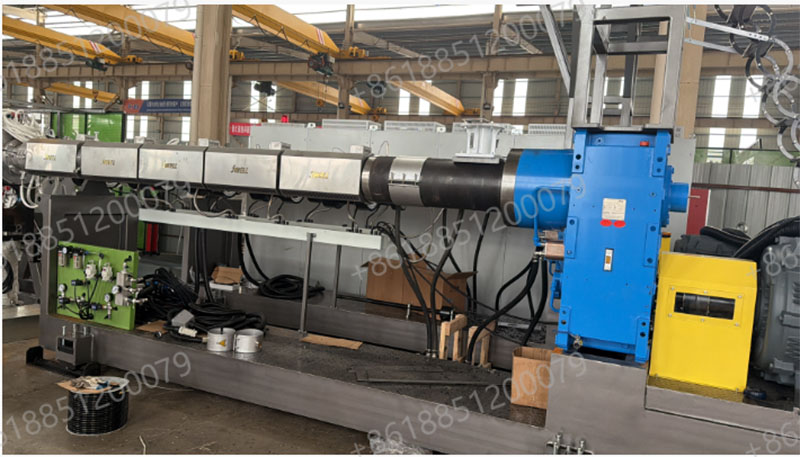
Extruder
The extrusion principle of an extruder is to use a screw with a beveled thread rotating in a heated barrel, forcing the plastic fed from the hopper forward. This process gradually heats and uniformly plasticizes the plastic, extruding it through the die head and mold. An extruder consists of an extrusion system, a heating and cooling system, a transmission system, and a control system. The extrusion system includes the screw, barrel, and feeding device. The screw is often referred to as the heart of the extruder; its quality directly determines the extrusion output and quality.
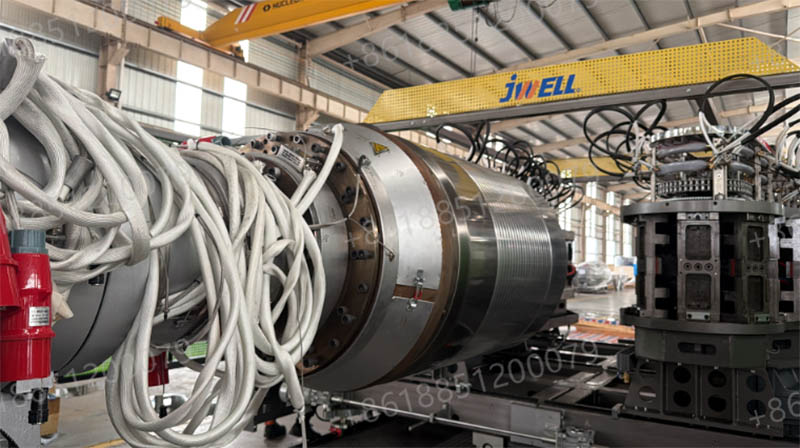
Die Head Assembly
The structure of the double-wall corrugated pipe extruder head is relatively complex. Its main feature is that it is divided into inner and outer flow channels within the same die, with compressed air flowing between the inner and outer channels to help form the corrugations on the outer layer on the forming module. Simultaneously, the cooling water pipe for the sizing sleeve also passes through the mandrel. To compensate for heat loss caused by the cooling water flow, the inner wall of the die head is generally heated. When producing large-diameter pipes, since polyolefin pipes are generally produced using single-screw extruders, whose extrusion volume is much smaller than that of twin-screw extruders, a two-extruder co-extrusion technology is typically used. This ensures production while increasing output. Small-diameter double-wall corrugated pipe production lines can use only one extruder to extrude both the inner and outer layers simultaneously.
Forming Machine
The corrugated pipe forming machine is a key piece of equipment in the production of corrugated pipes, affecting both the quality and output of the pipes. The forming methods for double-wall corrugated pipes are diverse and differ from those for other pipe forming equipment.
Based on module assembly method, it can be divided into two types: vertical and horizontal. Vertical forming devices allow modules to open and close vertically, have a small footprint, and a compact structure, but module replacement is more difficult, especially for large-diameter modules. Horizontal (also known as horizontal) forming devices allow modules to open and close horizontally (usually only available for large-diameter forming equipment), have a larger footprint, but module replacement is easier than with vertical devices. Furthermore, the modules are designed with cooling water circulation channels, using water as the cooling medium, significantly increasing production speed.
Based on the shaping method, it can be divided into two types: pneumatic shaping and vacuum shaping. Currently, some manufacturers use pneumatic shaping equipment, which involves applying compressed air through the ribs on the die core support and the screw plug fixed to the die core to the inner cavity of the outer tube blank, causing the tube blank to adhere tightly to the module and form corrugations. This equipment can produce products with arbitrary cross-sections, improve the quality of corrugated pipes, reduce thickness errors in the width of uneven corrugations, reduce scrap, and greatly simplify the structure of the internal cooling equipment and the die head. However, fluctuations in compressed air cause inconsistent corrugation peaks in the pipe, making it difficult to control the product's appearance.
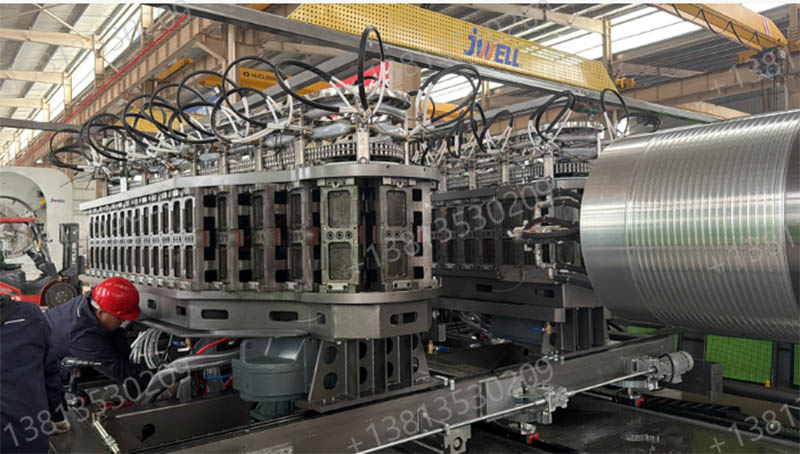
Forming Mold block
The forming mold for corrugated pipes is mainly the module, which determines the basic structure and dimensions of the pipe. The module's structure varies depending on the forming method and the module's movement trajectory. Currently, most production lines use vacuuming of the module to adsorb the blank onto the inner surface of the mold; therefore, the module must have channels for vacuuming. The structure of the forming module directly determines the ring stiffness of the pipe. The structure is shown in Figure 3:

Changzhou Jwell Machinery Co., Ltd. Established in 1997, JWELL has been ranked as top 1 in the Chinese extrusion industry for more than 15 consecutive years. As a global supplier of complete solutions for extrusion technology. JWELL has a long history and rich technology accumulation. With more than 1,016 patents and 9 production bases. Attending for endurance, striving for innovation and focus on customers' experience is JWELL'S permanent enterprise spirit, JWELL people actively confront with new industrial challenge and new materials and new processes. We constantly accelerate the research and development of new technologies, focus on the new energy utilization, automotive lightweight composite materials and medical disposables and medical packages. We commit to the cutting-edge technology of plastic processing and recycling. Continuously innovate and develop extrusion equipment in the polymer subdivision field. JWELL has a modern assembly workshops, 9 large components processing workshops and precision CNC machines. Unique processing technology, we strive to ensure the stability of each component. Pay attention to parts inspection and quality control and ensure the precision and reliability of all parts. Quality excellent, perfect as one.exceptional customer satisfaction. We understand and respect customers' vision and strategy. With our professionalism and dedication, we continuously improve the quality of our products, provide customers with overall solutions. And constantly create value for customers.


